
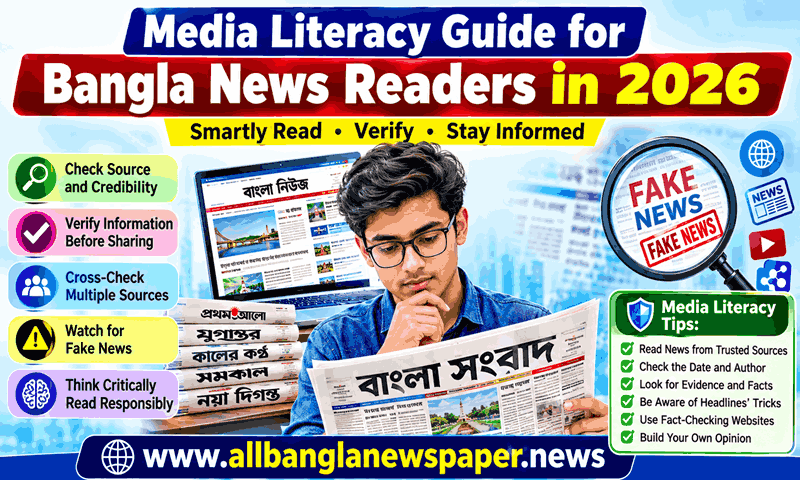
In 2026, Bangladeshi readers have more access to news than at any previous time in history. National dailies, regional newspapers, e-papers, online portals, social media pages, messaging apps, and video platforms all compete for attention. This abundance is a strength, but it also creates new difficulties. Not every source is equally reliable. Not every headline tells the full story. Political polarization, commercial pressures, speed-driven publishing, and the rapid spread of unverified claims make careful reading more important than ever.
Media literacy is the set of skills that helps readers navigate this environment. It does not require becoming a professional journalist or media scholar. It simply means learning to ask better questions about the information you consume, recognizing common patterns of bias or distortion, and building habits that favor accuracy over emotion or speed.
This comprehensive guide from allbanganewspaper.news offers practical media literacy tools tailored to Bangla and Bangladeshi news sources. It explains how to evaluate newspapers and portals, how to detect common problems in reporting, how to compare coverage across outlets, and how to build a sustainable critical-reading habit. The goal is not skepticism for its own sake, but informed confidence in the sources you choose to trust.
Why Media Literacy Matters in Bangladesh Today
Several features of the current media environment make these skills essential:
- The volume of information has exploded while attention remains limited.
- Social media and messaging apps often strip context from newspaper stories or circulate partial screenshots.
- Political and commercial interests influence story selection and framing in both subtle and obvious ways.
- Speed pressures can lead to errors that are later corrected quietly or not at all.
- Many readers rely on a single newspaper or a narrow set of social media pages, limiting their exposure to alternative perspectives.
- Misinformation and emotionally charged content spread faster than careful reporting.
Readers who develop basic media literacy are better equipped to form independent judgments, resist manipulation, and support higher standards of journalism by rewarding quality with their attention.
Core Questions to Ask About Any News Story
When you encounter a significant claim, pause and apply a simple set of questions:
Who is reporting this?
Is it a known newspaper with an identifiable editorial structure, or an anonymous page? Does the outlet have a track record?
What is the source of the information?
Are named officials, documents, data, or eyewitnesses cited? Or is the story based on vague “sources” or unverified social media posts?
What is the evidence?
Does the report provide verifiable facts, figures, dates, and locations? Can key claims be checked against other independent sources?
What is missing?
Are important perspectives, opposing views, or relevant background omitted? Does the story raise more questions than it answers?
How is the story framed?
Look at the headline, the lead paragraph, the choice of photographs, and the language. Is the framing neutral, alarming, celebratory, or accusatory?
Has this been reported elsewhere?
Major events are usually covered by multiple independent outlets. Strong agreement on core facts increases confidence; sharp divergence signals the need for caution.
These questions become faster and more automatic with practice.
Understanding Different Types of Bias
Bias does not always mean deliberate lying. It often appears in more everyday forms:
- Story selection bias – Choosing which events to cover and which to ignore.
- Placement bias – Giving some stories front-page treatment while burying others.
- Framing bias – Presenting the same facts through different interpretive lenses.
- Source bias – Relying heavily on one side of a conflict or one type of official.
- Language bias – Using loaded words, emotional adjectives, or partisan labels.
- Omission bias – Leaving out context, history, or counter-evidence that would complicate the preferred narrative.
No newspaper is completely free of these tendencies. The practical response is not to search for a perfectly neutral outlet (an unrealistic standard) but to read across a range of sources so that patterns of emphasis and omission become visible.
How to Compare Coverage Across Bangla Newspapers
One of the most powerful media literacy habits is cross-reading. When a major political, economic, or social event occurs:
- Read the lead story and editorial in two or three different national dailies.
- Note which facts appear consistently and which details differ.
- Observe differences in headlines, photograph choice, and length of coverage.
- Check a fast digital portal for additional updates or documents.
- If the issue has strong local impact, look at relevant regional reporting.
This practice quickly reveals both the solid core of a story and the areas where interpretation diverges. Over time it also teaches you the typical editorial tendencies of different newspapers without requiring you to accept any single outlet as authoritative.
Distinguishing News, Opinion, and Analysis
Quality newspapers usually separate these categories, but the boundaries can blur, especially on digital platforms and social media shares.
- News reports aim to present verified information about events.
- Opinion and editorial pieces openly argue for a particular interpretation or policy.
- Analysis sits in between, offering context and explanation while remaining more restrained than pure opinion.
Problems arise when opinion is presented as straight news, or when news reports are heavily loaded with interpretive language. Training yourself to notice the difference improves both comprehension and judgment.
Practical Habits for Everyday Media Literacy
Diversify your sources: Relying on only one newspaper or one social media circle limits perspective. A practical minimum is one or two major Bangla dailies plus occasional checks of another outlet or an English-language paper.
Prefer original reporting over forwards: Whenever possible, open the full article on the newspaper’s own website or e-paper rather than relying on screenshots, truncated posts, or secondary summaries.
Check dates and updates: Old stories sometimes recirculate as if they were new. Corrections and follow-up reports matter.
Be wary of emotional triggers: Headlines and posts designed to provoke immediate anger, fear, or triumph often deserve extra scrutiny before acceptance or sharing.
Look for primary documents when available: Budgets, court judgments, official statements, and data releases allow you to test reporting against original material.
Notice patterns over time: A single questionable story may be an error. Repeated patterns of distortion or omission reveal more about an outlet’s reliability.
Slow down before sharing: The decision to forward or post a claim is itself an act that affects the information environment. A short pause for verification is a form of civic responsibility.
Special Challenges in the Digital and Social Media Environment
Social media platforms and messaging apps amplify both good journalism and poor information. Common problems include:
- Headlines stripped of important qualifications
- Selective quoting that changes meaning
- Old images or videos presented as current
- Coordinated networks that artificially boost certain narratives
- Echo chambers that reinforce existing beliefs
The best defense is to treat social media as an alert system rather than a primary news source. When something important appears in your feed, return to established newspaper websites or e-papers for fuller context.
Media Literacy for Specific Audiences
Students and exam candidates: Critical reading improves the quality of current-affairs notes and written answers. Learning to distinguish reliable reporting from speculation strengthens analytical performance.
Diaspora readers: Distance can make verification harder and emotional reactions stronger. Relying on a small set of reputable newspapers and cross-checking major claims reduces the risk of being misled by incomplete or sensational material circulating in overseas networks.
General citizens: Everyday media literacy supports better personal decision-making and more constructive public conversation.
The Role of Quality Newspapers and Directories
Media literacy does not mean rejecting newspapers. It means using them more intelligently. Established newspapers with professional newsrooms, identifiable editors, and a public track record remain among the best available sources of verified information, even when they have editorial points of view.
A well-organized directory that brings major national dailies, regional papers, e-papers, and digital portals together makes it easier to practice comparative reading. Instead of being limited to one or two familiar sites, readers can efficiently check multiple perspectives.
allbanganewspaper.news supports this goal by reducing the practical friction of finding and switching between sources, so that critical reading becomes a realistic daily habit rather than an occasional effort.
Building a Sustainable Critical Reading Practice
Media literacy is a skill developed through repetition, not a one-time lesson. Start with small, consistent steps:
- Add one additional reputable newspaper to your regular reading.
- Practice the core questions on one major story each day.
- Once or twice a week, deliberately compare coverage of the same event across two outlets.
- Reduce reliance on unverified forwards and anonymous pages.
- Reward quality journalism with your attention and, where possible, legitimate support.
Over months, these habits reshape how you process information. You become slower to accept dramatic claims, faster at noticing missing context, and more confident in forming your own judgments.
Informed Readers Strengthen Journalism
The quality of a media environment depends partly on the quality of its audience. Readers who demand accuracy, notice bias, compare sources, and refuse to amplify unverified claims create incentives for better journalism. Those who consume passively or share indiscriminately make the work of careful reporting harder.
In 2026, Bangla newspapers and digital platforms offer unprecedented access to information about Bangladesh and the world. Media literacy ensures that this access translates into genuine understanding rather than confusion or manipulation.
Read widely. Question actively. Compare sources. Support the outlets that demonstrate consistent standards. These practices turn the abundance of news from a source of overload into a foundation for clearer thinking and more responsible citizenship.
The tools are available. The newspapers are accessible. The remaining step is the daily decision to read with both openness and care.